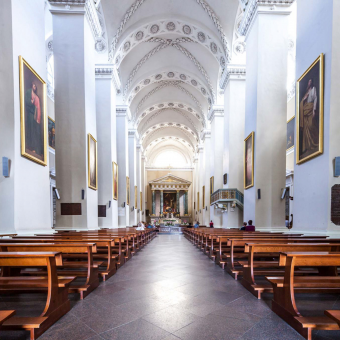
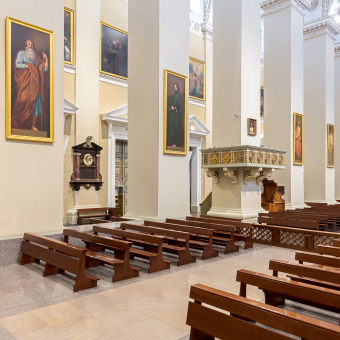
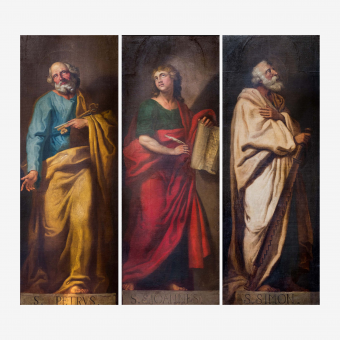
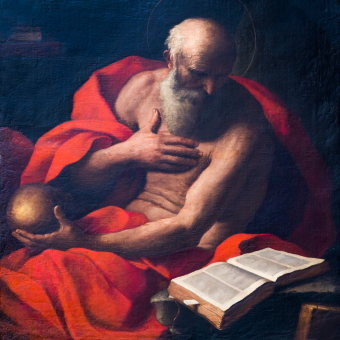
The paintings of the Twelve Apostles on the pillars of the central nave are by Franciszek Smuglewicz.
The artist Costantino Villani was invited from Italy to create 16 large paintings specifically for the cathedral. It is the most spectacular series of paintings on themes from Holy Scripture in Lithuania.
Facing the altar, scenes from the New Testament are depicted on the left side, and scenes from the Old Testament are depicted on the right.
On the right side, eight paintings representing stories from the Old Testament hang on the walls above the chapels between the pilasters. Walking from St Casimir’s Chapel towards the organ loft, they are: The Creation, Cain and Abel, Abraham’s Sacrifice of Isaac, Jacob’s Dream, Joseph in Prison, Moses at Mount Sinai, Joshua’s Victory and The Judgement of Solomon.
There are another eight paintings by Costantino Villani on the left side. Walking from the sacristy towards the organ loft, they are: The Annunciation by the Archangel Gabriel, The Nativity of Christ, The Massacre of the Innocents, The Adoration of the Magi, The Flight into Egypt, The Baptism of Christ, Jesus is Laid in the Tomb and The Descent of the Holy Spirit.
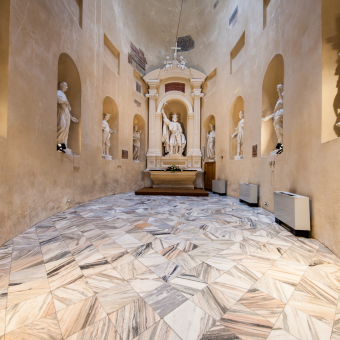
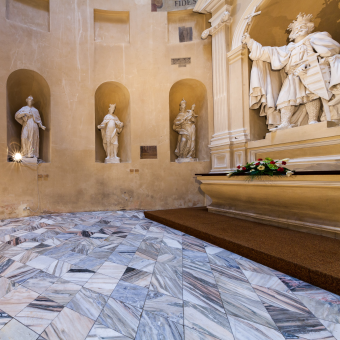
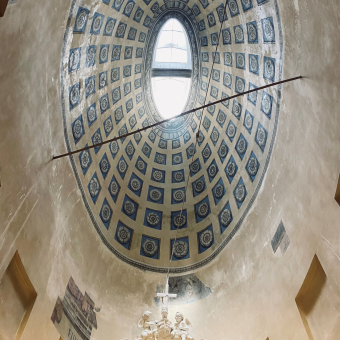
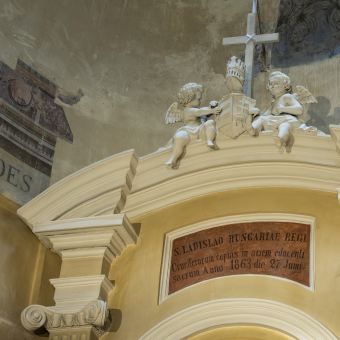
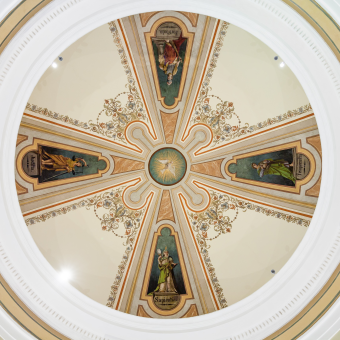
During the major reconstruction of the Cathedral (1783–1801), Laurynas Gucevičius designed the elliptical Chapel of St Ladislaus. Fragments of frescoes with the Latin inscriptions ZELUS (zeal) and FIDES (faith) have survived, and the altar, installed in the mid-19th century, features a plaster statue of St Ladislaus (1861–1863) by Henrik Dmochowski. In 2021, the restored dome decoration with illusionistic painting was revealed.
St Ladislaus is the patron saint of Hungary and of Vilnius Cathedral, associated with legends of miracles, military victories, and healing. Together with St Bishop Stanislaus, he is regarded as a patron of the Cathedral. During the Christmas season, a Nativity scene is displayed in the chapel.
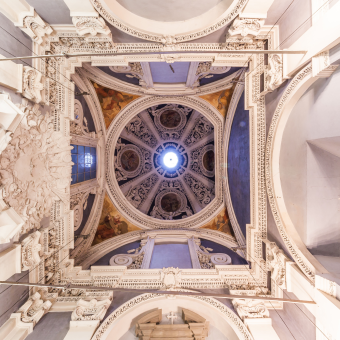
The Royal (Valavičiai) Chapel, built in the late 15th century by Casimir Jagiellon, was dedicated to the Blessed Virgin Mary, St Andrew, and St Stanislaus. Members of the royal family were buried here, and in the 16th–17th centuries the chapel was rebuilt and decorated under the care of Bishop Eustachius Valavičius.
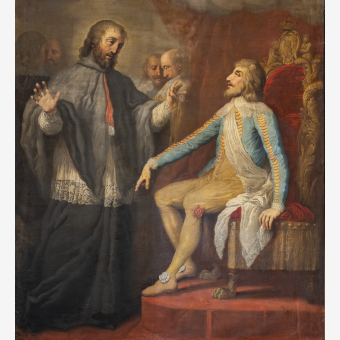
At the center of the altar is a 17th-century oval painting Immaculate Virgin Mary with two stucco allegorical figures. The dome features the evangelists and key events in Mary’s life: the Annunciation, the Visitation, the Assumption, and the Coronation. On the exterior wall is a 16th-century marble plaque with a Latin warning, and on the western wall hangs Franciszek Smuglewicz’s painting St John of Nepomuk before King Wenceslaus.
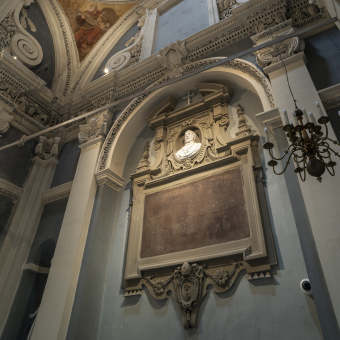
On the eastern wall, a memorial plaque commemorates the chapel’s founder, Bishop Eustachius Valavičius (1572–1630). In 2024, the chapel was consecrated, and the altar houses and venerates relics of St Boniface.
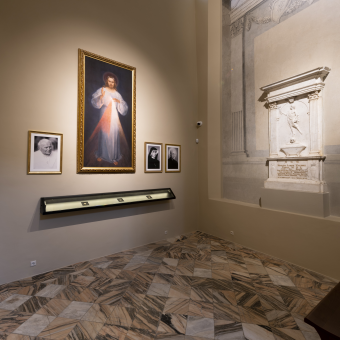
he chapel was founded in 1476 by Mikalojus Kęsgailaitis, Chancellor of the Grand Duchy of Lithuania and Voivode of Vilnius, a member of the Kęsgaila family. Initially dedicated to several saints, over time it acquired various names related to its patrons and the artworks once housed there. Because of this changing nomenclature, it is most commonly referred to in historiography as the First Kęsgaila Chapel.
Several historical monuments have survived in the chapel: memorial plaques dedicated to the Lithuanian nobleman Mykolas Zaleckis and to Vincentas Kliučinskis, Metropolitan Archbishop of Mogilev, as well as a unique brown marble plaque recounting the legend of the Vilnius Franciscan martyrs.
Following its restoration in 2020, the chapel was fitted with a modern mensa containing relics of St Faustina, Blessed Fr. Michał Sopoćko, and St John Paul II, with the image of the Divine Mercy displayed above.
The Chapel of St Stanislaus is one of the newest and most “hidden” chapels in the Cathedral. It appeared only after Laurynas Gucevičius’s reconstruction of the Cathedral and never had a separate foundation or an official title. Before Gucevičius’s rebuilding, the site of the present chapel was occupied by the Cathedral’s northern entrance, which during the reconstruction was shifted toward the High Altar. The newly created enclosed space was used as a storeroom until 1837, when the architect and representative of Vilnius Classicism, Prof. Karolis Podčašinskis (1790–1860), designed and installed a fixed Holy Sepulchre of Christ here. From that time, the space began to be called the Chapel of the Saviour’s Tomb. The chapel was opened only during the Easter Triduum and remained closed for the rest of the year. In this chapel, twice a year—on Good Friday and Holy Saturday—the Great Goštautai Monstrance was displayed.
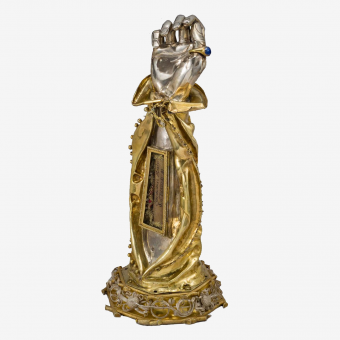
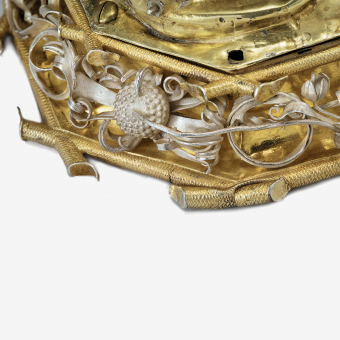
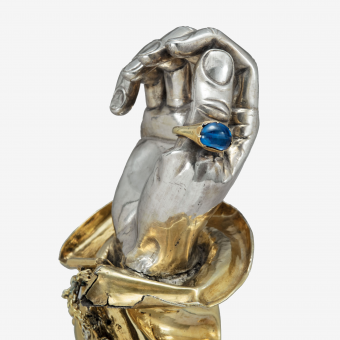
The chapel of the Cathedral’s titular saint also houses the most valuable treasure of Vilnius Cathedral, the oldest reliquary in Lithuania—the “Hand of St Stanislaus.” It belongs to the so-called “speaking” type of reliquaries, whose form reveals the relic contained within: a fragment of the hand bone of St Stanislaus, Bishop of Kraków. It is believed that the sapphire ring placed on the finger of the reliquary once belonged to a bishop and was donated to St Stanislaus as a votive offering. A document from 1503 records that the reliquary was solemnly displayed publicly in the cathedral twice a year, on the feast days of the holy bishop, on May 8 and September 27.
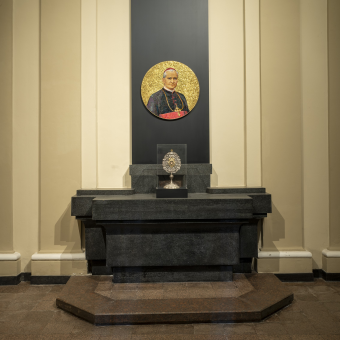
Since 2018, the relics of two Blessed Lithuanian bishops – Blessed Jurgis Matulaitis (1871–1927) and Blessed Teofilius Matulionis (1873–1962) – have been venerated in the historic St Peter’s Chapel. In the center of the chapel, above the reliquary containing Blessed Jurgis’s relics, there is a mosaic created in the Vatican workshops in 1987 for his beatification in Rome. On the left stands the reliquary of Blessed Teofilius, above which is a canonical image of the Blessed.
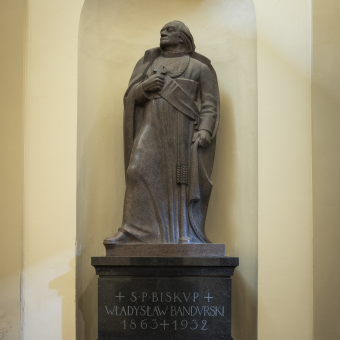
A reminder of earlier times is the tomb monument of Bishop Vladislovas Bandurskis (1865–1932) on the right side of the chapel, created in 1937 by the renowned sculptor Stanisław Horno-Popławski. The bishop’s remains were transferred to Poland, so this distinctive monument now serves a memorial function.
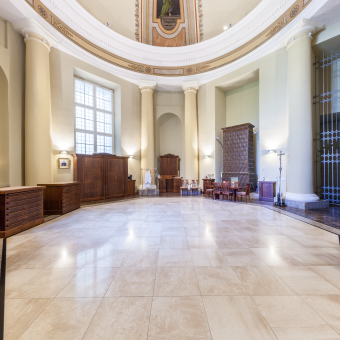
keeping liturgical vestments, items and books, and as a place for the priest to pray and prepare himself before the service.
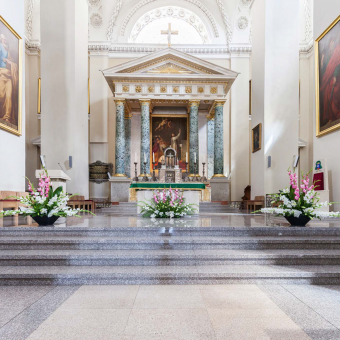
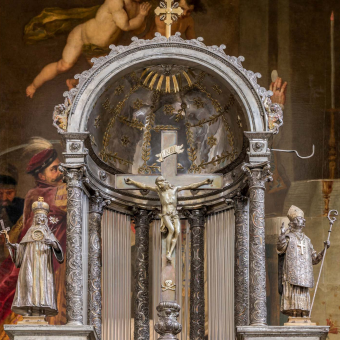
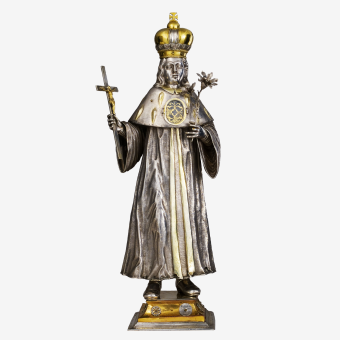
The altarpiece of the Cathedral Basilica’s main altar has three parts. The first, somewhat higher up than the others, bears a symbol of Divine Providence, above which there rises a cross with the figure of Christ. The second part features an elaborate tabernacle.
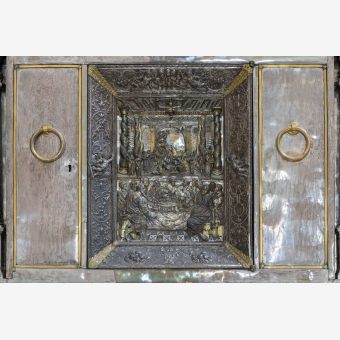
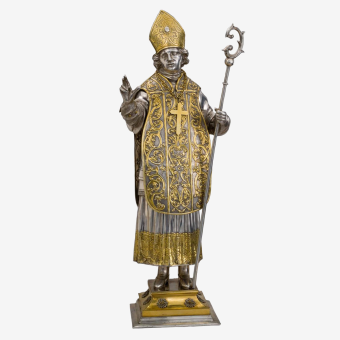
A tabernacle is an ornate box meant to hold the Most Blessed Sacrament. The Cathedral tabernacle was decorated with the scenes portraying the events of Holy Thursday: the Last Supper, Jesus washing the feet of his disciples, and his prayer in the Garden of Olives. Above the tabernacle there is a domed niche for a cross or a monstrance, beside which there are the statues of St. Casimir and St. Stanislaus – the patron saints of Lithuania and the diocese of Vilnius.
The new altar, where Holy Mass is now celebrated, was installed in 2007 in line with the indications of Vatican Council II.
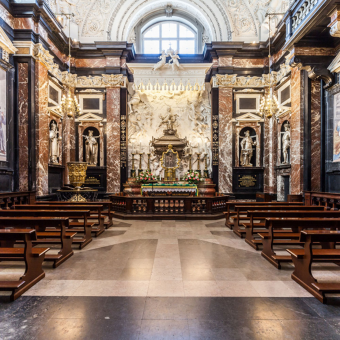
The Chapel of St Casimir is a particularly holy site in Vilnius Cathedral, and a special chapel that continues to attract tourists and pilgrims. Casimir (1458–1484) was the second son of Grand Duke Casimir of Lithuania (ruled 1440–1492). He achieved fame both for his ruling skills and for his pious way of life. He died very young, and was buried in Vilnius Cathedral, where believers soon started to witness various miracles. The canonisation process started not long after his death, but it remained unfinished throughout the 16th century. The prince was officially acknowledged as a saint in the early 17th century, a fact celebrated with huge festivities in Vilnius in 1604.
The present chapel was built in 1623–1636, at the initiative of Sigismund III Vasa, the grandson of St Casimir’s brother, and the great grandson Ladislaus IV Vasa. It was designed and built by the Italian architects Matteo Castello and Costante Tencalla. The chapel was the first building in the Grand Duchy of Lithuania to be decorated mainly with marble. Its exterior was embellished with slabs of sandstone, which were rare here. The prince’s remains were transferred to the chapel in 1636. In the late 17th century, the dome and the altar were adorned with magnificent works of stucco.
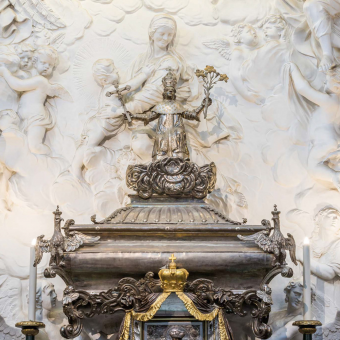
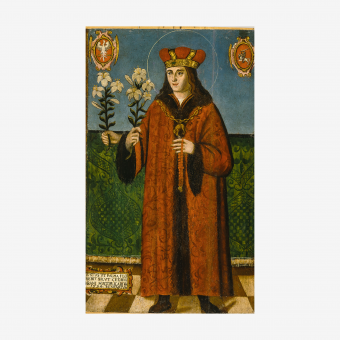
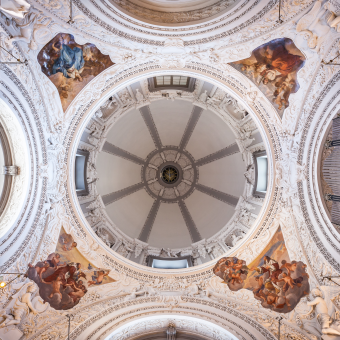
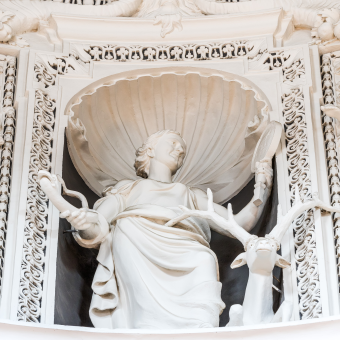
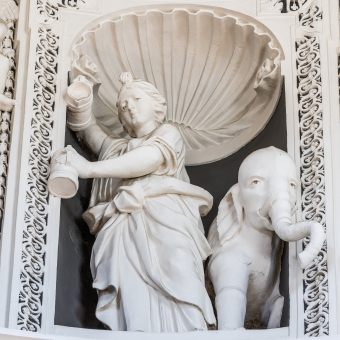
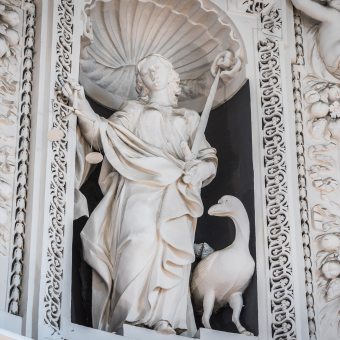
The decoration of the chapel’s dome refers to Casimir’s piety and virtue. Sculptures symbolising temperance, justice, fortitude and prudence stand in the niches between the windows.
The virtue of Justice is represented by a woman holding a pair of scales, a symbol of fairness and impartiality, in her right hand. In her left hand, she holds a sword to protect the righteous and punish the guilty. Next to her is an ostrich, a symbol of justice. It was believed that this bird can digest iron, and all its feathers are of equal length.
The virtue of Fortitude is symbolised by an armour-clad woman. In her right hand, she is holding an oak staff, showing strength of spirit; and with her left hand she is leaning on a column, signifying constancy. Next to her is a lion, a symbol of wisdom and power.
The figure depicting the virtue of Prudence is holding a mirror, a symbol of self-knowledge. In her right hand she is holding a fish, referring to well-judged, prudent actions. Next to her is an elk, which was considered a wise animal, for even when running swiftly it does not get caught up in shrubbery.
The figure representing the virtue of Temperance is diluting wine with water. An elephant standing nearby also embodies moderation. It was believed that this animal never eats more than necessary, and puts aside the rest for the next day.
There are four painted compositions in the dome’s pendentives: Chastity and Virtue above the entrance (by Franciszek Smuglewicz), and St Casimir’s Hymn to the Blessed Virgin Mary and St Casimir Accompanied to Heaven above the altar (by Michelangelo Palloni). At the apex of the dome is a dove, a symbol of the Holy Spirit.
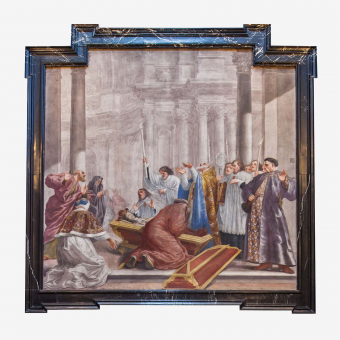
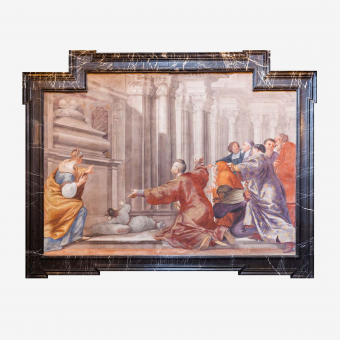

The chapel, founded in the 16th century by Bishop Jonas of the Lithuanian princely family and dedicated to St. Mary Magdalene, was later known as the Bishops’ Chapel, since the crypt beneath it served as the burial place of the bishops of Vilnius Cathedral. For a long time, the Blessed Sacrament was kept in the tabernacle on this chapel’s altar, and this title therefore also became established.
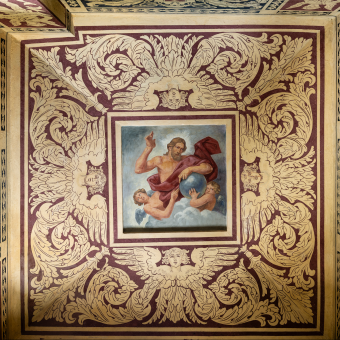
On the ceiling of the chapel there is a fresco depicting Christ blessing all the worshippers, flanked by two angels. At the beginning of the 20th century, the chapel was decorated with figures of angels, Eucharistic symbols, and monograms of Jesus Christ executed in the sgraffito technique. The author of these works was Jurgis Hoppenas.
An epitaph dedicated to Bishop Antanas Pranciškus Audzevičius (1833–1895) is installed on the eastern wall. On a white marble slab, a Latin text is carved in gilded letters, with the monogram—an abbreviated form of Christ’s name—below it. Above the slab are a crossed bishop’s staff and a cross, and higher up, in a niche, stands a marble bust of the bishop. Above the altar hangs an 18th-century painting “St. Thomas” by an unknown artist.
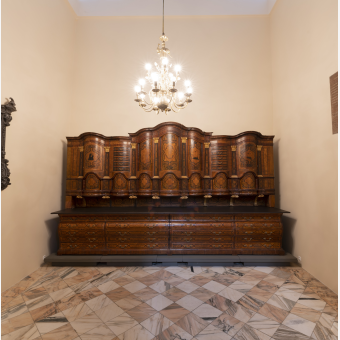
The main decoration of the Chapel of St. Ignatius of Loyola (the current cathedral sacristy) is a sacristy cabinet, a valuable work of art that arrived at the Cathedral in the 19th century from a Jesuit church somewhere in Lithuania. Designed as a container for liturgical inventory, the cabinet was used for its intended purpose from the 18th century, when it was made, until the 1950s. In 2021, the piece, intended for the respectful storage of consecrated liturgical items, was returned to the Cathedral in a chapel specially designated for it.
On the left wall is an epitaph dedicated to Bishop Jonas Civinskis (1772–1846), and on the right are two memorial plaques commissioned by Nicholas Radziwiłł the Orphan for his parents and other relatives.
The first Manvydai Chapel in Vilnius Cathedral was founded in 1423 by Albertas Manvydas, who, together with his brother Jurgis Gedgaudas, dedicated it to their patron saints and was buried there. After 1475, the chapel became the property of the Bishop of Vilnius, and later it was cared for by Jonas Glebavičius, associated with the Manvydai family.
During Laurynas Gucevičius’s reconstruction, the chapel was slightly shifted to make way for the southern entrance. In the 19th century, chapter records refer to it as St Paul’s Chapel, likely after the painting above the altar. The interior was partially damaged during the Soviet period; surviving elements include walls and ceilings decorated by Jurgis Hoppen (interwar period) with a fresco of St Paul’s Conversion.
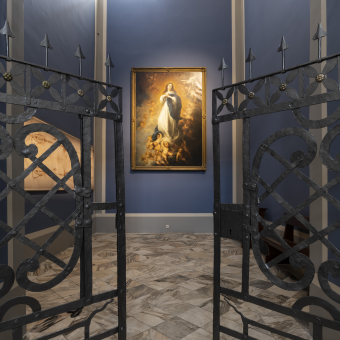
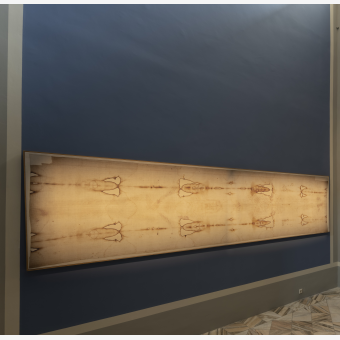
The chapel is adorned with a copy of Murillo’s Immaculate Conception of the Blessed Virgin Mary painted by Karolis Rafalavičius, acquired around 1858 by Fr. Antanas Zaleskis. In 2000, a reproduction of the Shroud of Turin was donated, venerated in the chapel since 2021, along with a copy of the 16th-century Mexican image of Our Lady of Guadalupe.
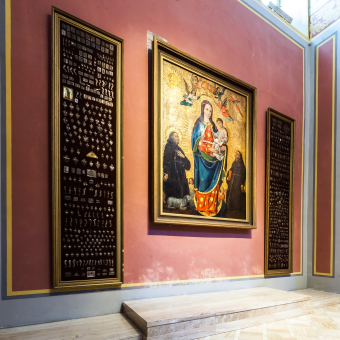
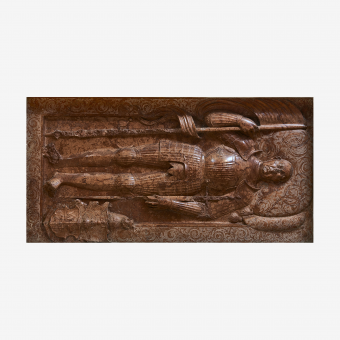
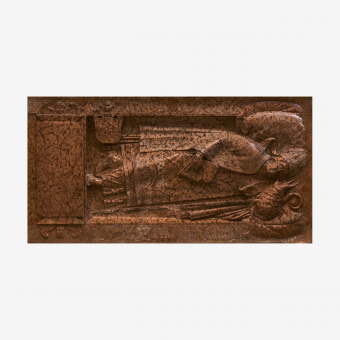
Built in the 15th century, the chapel belonged to the Goštautas (Gasztold) noble family, who are buried in the crypt below.
Two valuable 16th century tombstones have survived in the east and west walls of the chapel. The first is dedicated to Albertus Goštautas, the chancellor of the Grand Duchy of Lithuania (by Bernardo Zanobi da Gianotti). This is the oldest memorial sculpture in Lithuania. The influence of both Gothic and Renaissance art forms are obvious. The second tombstone is dedicated to Bishop Paulius (Povilas) Alšėniškis (Pawel Holszański) (by Giovanni Maria Padovano).
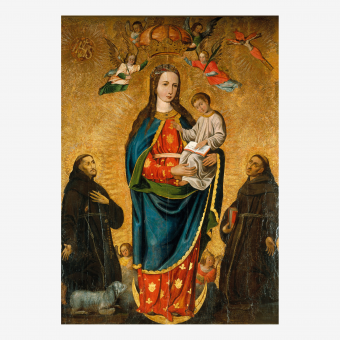
The highlight of the chapel is the painting "Our Lady of St Michael", which is more usually called "The Madonna of the Sapiehas". This image of the Blessed Virgin Mary with the Franciscan saints Francis and Bernardine has been famous for its miracles since the 16th century. Formerly kept in the Bernardine Church, the painting later belonged to the Bernardine convent’s Church of St Michael the Archangel. The name "The Madonna of the Sapiehas" refers to the name of the family who endowed the convent. Miracles worked in the presence of the painting were recorded, and on 8 September 1750 the image was decorated with crowns sent by Pope Benedict XIV (the frame and the crowns have not survived). It was the fourth holy image in the Grand Duchy of Lithuania to be crowned (and the second oldest in Lithuania today).
In 2020, through the efforts of the Cathedral community, the crowns of Our Lady and Infant Jesus were restored and adorn the painting again.
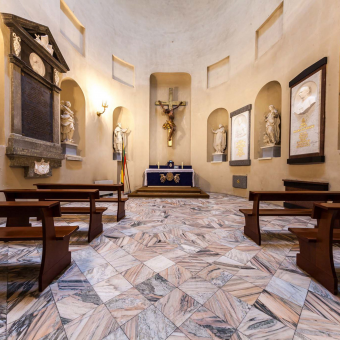
Since 1989 this chapel has been dedicated to the memory of the killed, imprisoned or exiled during the Soviet era. The chapel has three inscriptions commemorating Bishops of Vilnius: Bishop Jan Nepomucen Kossakowski (1755–1808), Bishop Mečislovas Reinys (1884–1953), and Bishop Julijonas Steponavičius (1911–1991).The niches in the walls contain eight sculptures of saints, above which little angels hold symbols of the virtues (work of Pranciškus Smuglevičius). The sculpture of the Crucified Christ was transferred to the chapel from the Church of the Trinitarians, which was closed in 1864.